


Cirque Mechanics Resource Guide
Tilt! A Circus Thrill Ride
School Matinee
Cirque Mechanics: Tilt! A Circus Thrill Ride
Monday, October 26, 2026 • 11:00am-Noon
Welcome to Tilt! A Circus Thrill Ride.
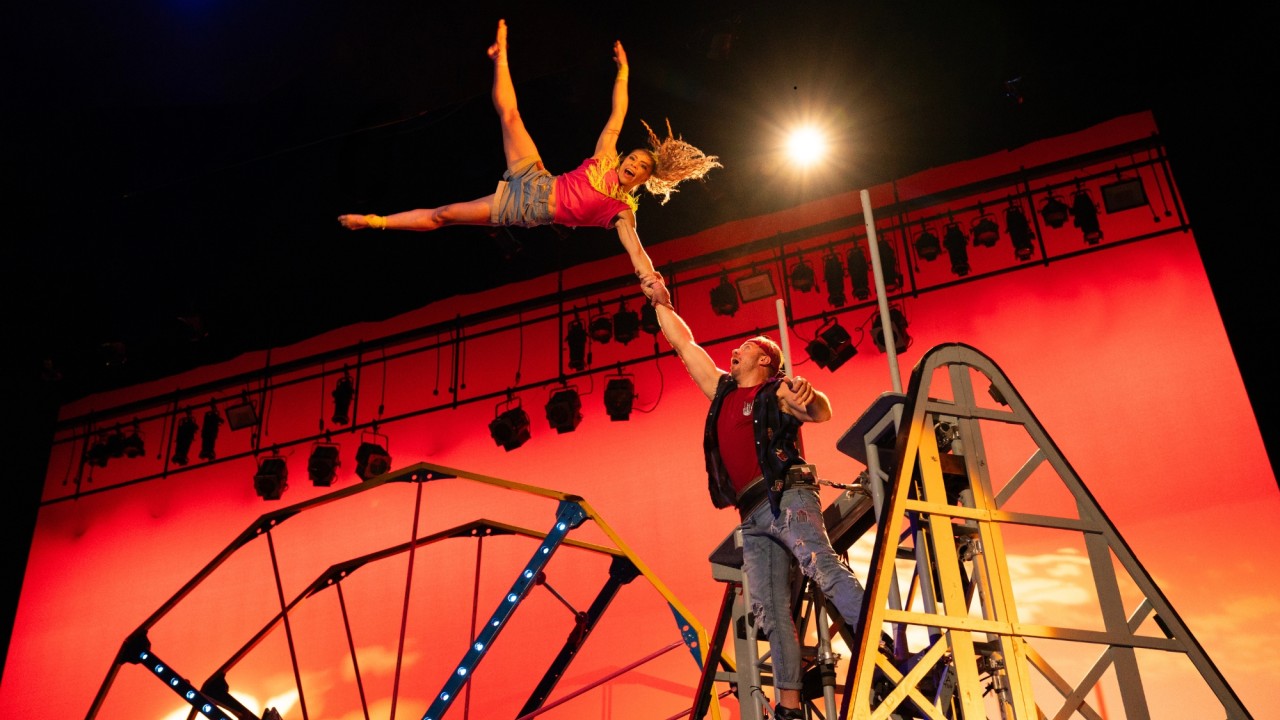
We are so excited that you will join us on this thrilling journey through amusement park rides, daring circus feats, and the unforgettable culture of the 1980s. At Cirque Mechanics, we believe circus is not just entertainment—it’s a way to explore science, history, art, and storytelling all at once. When we began creating Tilt!, we asked ourselves: What if we could step inside the amusement parks of our childhood? What if the rides, the music, the games, and the colors of the 1980s came alive on stage through circus? The answer became a show powered not by electricity or engines, but by people—artists who flip, balance, fly, and spin to recreate the magic of the rides you know.
The story follows a weary amusement park worker, worn down by the grind and long disconnected from the joy around him. When he confiscates a guest’s boom box, a playful chase erupts—an exhilarating whirlwind of stunts, surprises, and laughter. By the end, the pursuit transforms into a touching moment of connection, proving that even in the unlikeliest of places, shared joy can bring us together.
Tilt! is meant to inspire curiosity and creativity. Enjoy the ride!
––The Cirque Mechanics Team
Videos
Additional Video:
Russian Cradle (2:20)
Interesting To Know
The Cirque Mechanics team is known for designing custom “performance machines.” For previous shows, they created a giant pedal-driven gantry crane (Birdhouse Factory) and a 20-foot windmill (Zephyr). Tilt! is their biggest playground yet!
Inspiration
The creators studied real amusement park rides—Tilt-a-Whirls, Zippers, Loop-O-Planes—and asked: How can circus performers become these rides? The answer came through engineering unique machines, each designed to move in surprising, human-powered ways. Why the 1980s for Tilt!? The 1980s amusement park was the perfect mix of innocence, thrill, and nostalgia. It was a place where kids could roam free, parents could relax, and everyone shared in the excitement. That sense of wonder is exactly what Tilt! aims to bring back.
Design Highlights
The stage design for Tilt! is like stepping into a time machine that takes you straight to the summer of 1986. The world feels familiar—rides, booths, bright colors—but with a circus twist.
The Ferris Wheel: A giant circle structure is the centerpiece of the show. Unlike a theme park, it has no motors—just human energy.
Roller Coaster Tracks: Curved ramps and rails double as platforms for balancing, acrobatics, and slides.
Props as Machines: Trash cans, benches, even a snack cart transform into circus equipment. Nothing is just what it seems.
Lighting & Color: Neon pinks, electric blues, and bold yellows recall the fashion and graphics of the 1980s.
Simple Machines on Stage
A simple machine is a tool that makes work easier by changing the direction or strength of a force. Amusement park rides—and circus acts—use them all the time.
Wheel & Axle: A wheel attached to a central rod to help move objects more easily. As seen in Tilt!: Ferris Wheel, Tilt-A-Whirl, spinning plates
Pulley: A wheel with a rope or belt that lifts or moves objects. As seen in Tilt!: Swing Ride aerial lifts, aerial, rigging
Lever: A rigid bar that pivots to lift or move something. As seen in Tilt!: Teeter Board act
Inclined Plane: A sloped surface to move objects up or down. As seen in Tilt!: Skateboard ramps, slides
Screw: A spiral-shaped tool to hold or lift objects. As seen in Tilt!: Hidden in ride assembly, props, and stage machinery
Wedge: A shape that splits, lifts, or secures objects. As seen in Tilt!: Tools, stage set assembly, props
Newton’s Laws of Motion-to flip, fly and spin
Sir Isaac Newton’s laws of motion explain the relationship between a physical object and the forces acting upon it. Understanding this information provides us with the basis of modern physics.
- INERTIA: An object at rest remains at rest, and an object in motion remains in motion at constant speed and in a straight line unless acted on by an unbalanced force.
- FORCE EQUALS MASS TIMES ACCELERATION: The acceleration of an object depends on the mass of the object and the amount of force applied.
- ACTION & REACTION: Whenever one object exerts a force on another object, the second object exerts an equal and opposite on the first.
Circus Physics in Action
On stage, which acts show friction, torque, or momentum in the most exciting way?
CENTRIPETAL FORCE: THE FORCE THAT PULLS OBJECTS TOWARD THE CENTER OF A CIRCLE – Keeps riders on the Ferris Wheel or Tilt-Awhirl
MOMENTUM: HOW MUCH MOTION AN OBJECT HAS; HARDER TO STOP A ROLLING BOWLING BALL THAN A TENNIS BALL – Helps jugglers and tumblers maintain motion.
TORQUE: A TWISTING FORCE THAT MAKES OBJECTS ROTATE – Powers spin tricks and aerial rotations.
FRICTION: A FORCE THAT SLOWS MOVEMENT – Useful for safety and controlling props, but slows juggling or spinning tricks.
Learn More:
Attending The Theater: What is expected of student audiences at the matinee
Smithsonian Institution: History of Amusement Parks: The Traver Circle Swing Company
PBS: American Experience: Coney Island
HowStuffWorks – How Roller Coasters Work
Classic Tilt a Whirl Ride at the CNE
You can also follow Cirque Mechanics on Facebook, Instagram, and their website.
California Arts Standards
The 2019 California Arts Standards provide guidance toward a common goal: for all California students to fully participate in a rich and well-rounded arts education. The standards are based on the artistic processes of creating; performing/producing/presenting; responding; and connecting. Our school matinees correspond to responding and connecting:
- Responding—Anchor Standard 7: Perceive and Analyze Artistic Work; Standard 8: Interpret Intent and Meaning in Artistic Work; Anchor Standard 9: Apply Criteria to Evaluate Artistic Work
- Connecting—Anchor Standard 10: Synthesize and Relate Knowledge and Personal Experiences to Make Art; Anchor Standard 11: Relate Artistic Ideas and Works with Societal, Cultural, and Historical Context to Deepen Understanding
Common Core Standards
Common Core broadens the definition of a “text,” viewing performance as a form of text, so students are experiencing and interacting with a text when they attend a performance. Seeing live performance provides rich opportunities to write reflections, narratives, arguments etc.
CCSS.ELA-LITERACY.CCRA.W.3, CCSS.ELA-LITERACY.CCRA.W.6, CCSS.ELA-LITERACY.CCRA.L.3