


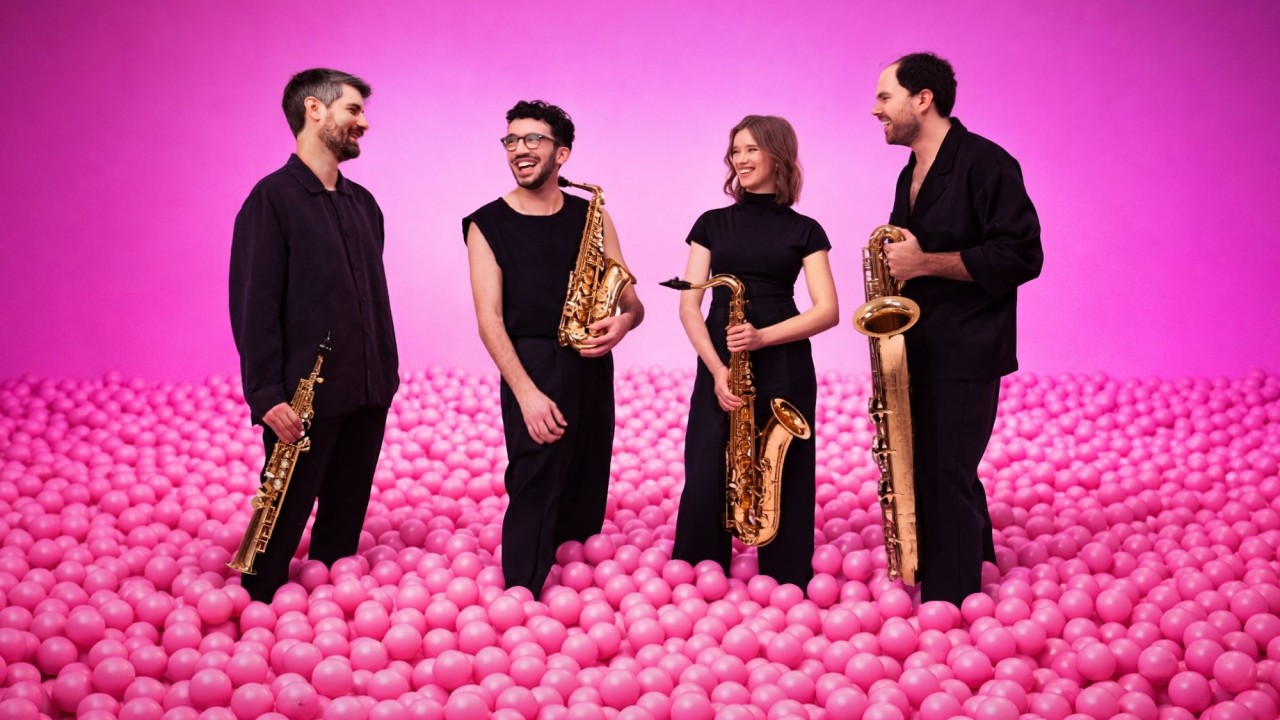
Program Notes for Arcis Saxophone Quartet
Arcis Saxophone Quartet
Claus Hierluksch, soprano saxophone
Bernardo Pereira, alto saxophone
Sonia Tcherepanov, tenor saxophone
Jure Knez, baritone saxophone
Program
| Prelude in C Minor (“Bach to the Future”) | Aleksey Igudesman |
| Fugue in C Minor, BWV 847 | Johann Sebastian Bach |
| Prelude in C-Sharp Minor (“Prelude Reexplored”) | HueyChing Chong |
| Fugue in C-Sharp Minor, BWV 849 | Johann Sebastian Bach |
| Prelude in D Minor | Theresa Zaremba |
| Fugue in D Minor, BWV 851 | Johann Sebastian Bach |
| Prelude (“Momentum”) | Nyokabi Kariuki |
| Fugue in E-Flat Major, BWV 852 | Johann Sebastian Bach |
| Selections from 24 Preludes and Fugues, op. 82 | Nikolai Kapustin |
| Selections from Preludes and Fugues, op. 87 | Dmitri Shostakovich |
| Selections from Preludes and Fugues, op. 87 | Chopin / Radiohead / Brad Mehldau |
| Prelude, Fugue & Riffs | Leonhard Kuhn / Leonard Bernstein |
Program Notes
Here, everything revolves around Bach’s Well-Tempered Clavier. We are recording all 48 fugues in a new version for saxophone quartet and have commissioned 48 composers from around the world to write one new prelude each. The result is a diverse and exciting collection, from which excerpts can be heard in this program, complemented by works that are all inspired by The Well-Tempered Clavier.
— Arcis Saxophone Quartet
A Primer on Preludes and Fugues
It started as a bit of noodling around, a quick check that the strings were in tune or the organ pipes were getting air. That noodling evolved into a short chord progression meant to establish the key center before launching into a contrapuntal piece such as a ricercar or fugue. That chord progression acquired ornamentation and shape, and thus was born the prelude, from Latin words for “playing before.” Shortly after the turn of the 18th century the German composer Johann Caspar Ferdinand Fischer published his Ariadne musica, 20 paired preludes and fugues that cycle through the keys from C Major onwards. The title refers to the ball of thread that guided Ariadne through the Minotaur’s labyrinth, a nice parallel to all those keys and modes.
There’s ample evidence that Johann Sebastian Bach knew the Ariadne. He put together his first collection of 24 Fischer-inspired preludes and fugues, The Well-Tempered Clavier, around 1722, although quite a few of the pieces had been written earlier. Demonstrating how recently evolved tuning systems made it possible to play in all the major and minor keys on a clavier, it also illustrates the unique sound world of each key. Bach got so much mileage out of his first collection that he created a second volume in 1742.
It’s hard to imagine a world without The Well-Tempered Clavier, or WTC. Those 48 preludes and fugues are core repertory to all keyboard players, whether neophyte or mature master. So it shouldn’t be surprising that the WTC has also provided abundant fodder for compositional reworkings and rethinkings.
Prelude in C Minor, Bach to the future (2021)
Aleksey Igudesman
Born in Leningrad, Russia, July 22, 1973
Fugue in C Minor, BWV 847 (1722)
Johann Sebastian Bach
Born in Eisenach, Germany, March 31, 1685; died in Leipzig, Germany, July 28, 1750
Aleksey Igudesman created this alternate prelude for the C Minor fugue as a bridge between old world and new. It opens by outlining the basic chord progression of Bach’s prelude. Before long, part of the ensemble is playing something approximating Bach’s original, but with melodic additions that include wry references to Beethoven’s Fifth Symphony, another celebrated work in C Minor. (Careful listening will reveal a bit of the Mozart G minor symphony as well.)
The fugue that follows is Bach’s own, a spectacular illustration of multum in parvo—i.e., extracting an extraordinary amount of musical material from just a few ideas; in this case, a descending four-note figure that matches the chord progression from the prelude, together with a simple lower-neighbor-tone figure.
Prelude in C-sharp Minor,Prelude Reexplored (2021)
Huey Ching Chong
Born in Malaysia, 1986
Fugue in C-sharp Minor, BWV 849 (1722)
Johann Sebastian Bach
Born in Eisenach, Germany, March 31, 1685; died in Leipzig, Germany, July 28, 1750
The Arcis Saxophone Quartet has commissioned new preludes for all 48 of the fugues in Bach’s Well-Tempered Clavier. Huey Ching Chong supplies this “Prelude Reexplored” for the C-sharp minor fugue, one of the musical peaks of the WTC’s first volume. Trained in Japan, she has become a composer for the world who explores sound canvases and non-traditional uses of instruments.
Commentator and theorist Hugo Riemann has referred to the magnificent 5-voice triple fugue in C-sharp minor as the “holy of holies.” The label is apt. The fugue’s short, ricercar-like subject is combined with two other subjects (and their attendant countersubjects) into a majestic edifice that gradually accumulates tension before resolving in a shining major chord.
Prelude in D Minor
Theresa Zaremba
Born in Germany, 1991
Fugue in D Minor, BWV 851 (1722)
Johann Sebastian Bach
Born in Eisenach, Germany, March 31, 1685; died in Leipzig, Germany, July 28, 1750
Munich-based Theresa Zaremba brings her “ambient chamber pop” blend of chamber music, electronics, indie-pop and experimental textures to her take on the D minor prelude from the WTC. The driving triplets of Bach’s prelude are actually chord outlines, reflecting the preludes’ origins in organ improvisations. The Fugue’s subject is a simple rising figure that Bach subjects to spectacular manipulations, including flipping it upside down (inversion) and even stating the flipped version simultaneously with the original.
Prelude, Momentum
Nyokabi Kariuki
Born in Kenya, 1998
Fugue in E-flat Major, BWV 852 (1722)
Johann Sebastian Bach
Born in Eisenach, Germany, March 31, 1685; died in Leipzig, Germany, July 28, 1750
Kenyan Nyokabi Kariuki wears her East African heritage proudly as she aims to blur the lines between electronic music, contemporary-classical, film scores, sound canvases, and even field recordings. Her goal is to “create meaningful and challenging art, illuminated by a commitment to the preservation of African thought, language and stories.”
Kariuki reimagines a particularly rich piece with the Prelude in E-flat major; as the old joke goes, “When is a prelude not a prelude? When it’s a fugue!” This is indeed a prelude that contains its own fugue, and not just any old fugue, either—it’s a double fugue, i.e., one with two subjects instead of just one.
The “real” fugue that follows easily ranks among Bach’s most joyous. Short, trim, bouncy and almost irresistibly dancelike, it is as pithy as the Prelude is expansive.
Selections from 24 Preludes and Fugues, op. 82 (1997)
Nikolai Kapustin
Born in Horlivka, Ukraine, November 22, 1937; died in Moscow, Russia, July 2, 2020
There’s an old saying that what doesn’t kill you makes you stronger. Justifiable or not, it certainly seems to apply in the case of Nikolai Kapustin, who faced personal and professional ruin on a number of occasions but emerged intact nonetheless. The first time occurred when he was just a little boy; the Nazis invaded his native Ukraine in 1941 and life was upended. But he made it through, scrawny from malnutrition to be sure, but he made it. Later on he barely escaped being expelled from the Moscow Conservatory when, as a student of the legendary piano teacher Alexander Goldenweiser, he hung forbidden modernist paintings in his dormitory as a joke. Post-graduation, he faced professional catastrophe of a different sort: a state-mandated job teaching accordion out in the middle of nowhere, a career killer if ever there were. It took Goldenweiser’s intervention to get him out of that one.
He was, in short, a super-survivor. Private and modest, his reticence was easily mistaken for weakness. It was nothing of the sort; Kapustin was strong-willed, intolerant of hypocrisy or pretense, politically cynical, and staggeringly brilliant. There exists a proximate parallel universe in which Nikolai Kapustin developed into another Emil Gilels or Sviatoslav Richter—i.e., a Soviet-trained concert pianist who became a world phenomenon. But we don’t live in that one. In our space-time continuum Kapustin remained a closely guarded secret until the dissolution of the Soviet Union and the gradual discovery of both his music and his playing by the rest of the world.
It’s very much in character that he came to embrace jazz, which in the Soviet Union was essentially the path of maximum resistance. Like his colleague Alexander Tsfasman, he had to learn jazz from smuggled recordings and Voice of America broadcasts. But he used that painfully gleaned knowledge to create a spectacular catalog of jazz compositions that are fast becoming core piano repertory.
We can hear Kapustin playing his epic 24 Preludes and Fugues, op. 82—his own Well-Tempered Clavier—thanks to a monumental 4-day session in September 2000 in which the 63-year-old pianist recorded the massive hour-and-a-half cycle, performing entirely from memory. The pieces are startlingly vivid fusions of jazz with Bachian counterpoint, and they’re played by a master pianist with rock-solid technique and a vibrant rhythmic sense. Just as Bach’s Well-Tempered Clavier encompasses all the genres, styles, and idioms of Bach’s era, so Kapustin’s op. 82 covers the gamut of jazz piano styles, from boogie-woogie to stride to blues. But there is no improvisation here; everything is meticulously written out, and Kapustin’s recorded performances are scrupulously adherent to his own notation.
One can’t help but wonder how Bach might have reacted to hearing that Kapustin recording. It’s safe to say that, as a virtuoso keyboard player himself, he would have immediately recognized Kapustin’s sterling worth as both composer and performer, no matter how alien the jazz idiom might have been to Bach’s Lutheran-infused personality.
Selections from Preludes and Fugues, op. 87 (1950–51)
Dmitri Shostakovich
Born in Saint Petersburg, Russia, September 25, 1906; died in Moscow, Russia, August 9, 1975
The legendary piano teacher Alexander Goldenweiser once claimed that the three most talented people he had ever known were Sergei Rachmaninoff, Nikolai Kapustin, and Tatiana Nikolayeva. That third name might not ring a bell right off. Like many Soviet musicians, she was largely cut off from the larger musical world, although in the years following WWII she taught in Germany and eventually began performing worldwide. She died in 1993, nine days after a brain hemorrhage during a performance at San Francisco’s Herbst Theater.
She was stricken while playing one of Dmitri Shostakovich’s op. 87 preludes and fugues. Shostakovich had written the mammoth set for her in 1950-51, when she won the first prize at the International Johann Sebastian Bach Competition in Leipzig. The monumental work is Shostakovich’s homage to Bach’s Well-Tempered Clavier, but it is organized differently: whereas the WTC ascends through the cycle of major and minor keys chromatically (C Major – C Minor – C# Major – C# Minor, etc.), Shostakovich traverses the circle of fifths, thus C Major – A Minor – G Major – E Minor, etc.
There are some other differences between Shostakovich and Bach’s great cycles. For one thing, Shostakovich’s preludes are more tightly integrated with their fugues. And whereas Bach covers a wide range of emotions, Shostakovich’s mood palette is mostly dark, albeit with occasional lighter flashes. (The work was written at the height of the Stalinist repression, after all.) That overall gloom has limited the set’s public appeal, but beyond a doubt it “assures us that Shostakovich is among the handful of great composers of the 20th century,” according to musicologist Wilfrid Mellers.
Both Shostakovich and Nikolayeva left us recordings of the entire cycle, and pianists such as Vladimir Ashkenazy have also taken the plunge. Furthermore, individual pieces have been arranged or transcribed for numerous instruments including organ, accordion, double bass with piano, string orchestra, and (of course!) saxophone quartet.
Exit Music (1835/1997/1998)
Chopin / Radiohead / Brad Mehldau
It starts with Frédéric Chopin’s Prelude in E Minor, fourth of the op. 28 set inspired by Bach’s WTC, a hypnotic Largo in which a deceptively simple melody unfolds over steady slow chords in the bass, eventually rising to a climax then subsiding back down into the calm with which it began.
Then film director Baz Luhrmann steps in. He wanted a song for his forthcoming film Romeo + Juliet with Leonardo DiCaprio and Claire Danes, so he approached the English rock band Radiohead with the project. They created their song “Exit Music (For a Film)” as not only underlying music based (lightly) on Chopin’s prelude, but as a summary of Shakespeare’s immortal story. Ranked among Radiohead’s best songs by numerous critics, it can be found on their 1997 album OK Computer.
Enter jazz pianist, composer and arranger Brad Mehldau. For his 1998 album Songs: The Art of the Trio, Vol. 3, he provides an imaginative cover that reinterprets the Radiohead song without the words, with an added layer of suave jazz idioms.
Now comes the Arcis Saxophone Quartet, performing their own version of the Mehldau cover of the Radiohead original with its Chopin underpinning.
Prelude, Fugue & Riffs (2026)
Leonhard Kuhn
Born in Germany, May 9, 1987
Leonard Bernstein
Born in Lawrence, Massachusetts, August 25, 1918; died in New York, New York, October 14, 1990
He’s a composer, mathematician, guitarist, electronics engineer, and part-time philosopher. Leonhard Kuhn loves to smoke, hates wearing uniforms, and never does what people necessarily expect him to do. His Jazzrausch Bigband might be a commercial endeavor, but it avoids trivialities with a vengeance. All of this makes him an ideal candidate to work with the always-adventuresome Arcis Saxophone Quartet, and so far their collaborations have resulted in some pretty extraordinary stuff.
Of late, we have the Kuhn “take” on Leonard Bernstein’s 1949 Prelude, Fugue and Riffs, dedicated to clarinet great Benny Goodman. Electronic processing adds a rich underlying techno element to this almost completely reimagined version of a work that was already a delectably busy-beaver romp, all aglow with hot-jazz styles and smoking brass passages now taken over by the four Arcis saxophones.
— SCOTT FOGLESONG
Scott Foglesong is the Chair of Music Theory and Musicianship at the San Francisco Conservatory of Music. A Contributing Writer and Pre-Concert Lecturer for the San Francisco Symphony, he also writes program notes for the California Symphony, Oregon Symphony, and Grand Teton Music Festival, among other groups. As a pianist, he studied at the Peabody Conservatory and SFCM.
About the Artists
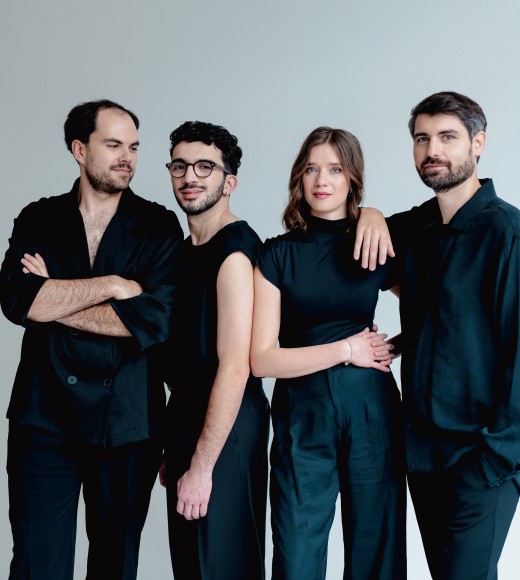
"A performance full of energizing sound and a harmoniously developed musicality, effortlessly captivating the audience."
The Arcis Saxophone Quartet, named after Munich's iconic Arcis Street, has emerged as one of the most vibrant and active classical ensembles globally. Whether on the highest pass in Ecuador, in the middle of the Saudi Arabian desert, on the cliffs in the American Atlantic, or in the sold-out Philharmonie in Munich and Berlin, the four saxophonists feel at home everywhere with their music. Embodying a spirit of experimentation, artistry and boundless curiosity, the quartet fearlessly explores new musical territories.
Whether they are traveling and performing on a trailer-turned-stage through Bavarian villages, pedaling through the city on a Conference-Bike, or innovatively combining chamber music with contemporary dance in a joint performative act through their arcis_collective, their creativity knows no bounds. An elaborate dramaturgy, sound and light design, as well as captivating introductions, are as much a part of the concert experience for the four multi-talented musicians as their energetic interpretations, finely balanced arrangements, and commissioned compositions from all over the world, tailored to their style.
To stay true to themselves, their artistic vision flows into all aspects of their work: After their two debut CDs, Arcis Saxophon Quartett spielt Enjott Schneider (2013) on Ambiente Audio and Rasch (2017) on Genuin, the four musicians founded their own record label, arcis records, and established arcis visuals, a production company in-house, taking care of their visual and media content.
They acquired their chamber music skills from the best of the best, studying with the Artemis Quartet at the UdK in Berlin and in the forge of the European Chamber Music Academy (with mentors like Hatto Beyerle, Alban Berg Quartet; Prof. Johannes Meissl, among others), as well as at the HMT Munich with Prof. Koryun Asatryan and Prof. Friedemann Berger.
International success quickly followed. The press cheered, "A world-class quartet," and the competition successes and awards poured in. They won first prizes at the Music Competition of the Kulturkreis Gasteig e.V. (Munich; additional audience prize), at the International Music Competition Concorso Argento (Italy), and at the First Classical Music International Internet Festival "Chance Music" (Russia). They received a third prize at the 13th International Chieri Music Competition (Italy). In 2014, they were awarded the second prize at the Chamber Music Competition of the Alice-Samter-Stiftung (Berlin), and in 2015, they won the first prize at the 4th International Contest – Festival of Chamber Ensemble Performance named after T.A. Gaidamovich in Magnitogorsk (Russia). In 2016, they received the first prize at the 1st Rising Stars Grand Prix 2016 – International Music Competition Berlin.
Recognized for their outstanding contributions to the world of classical music, the quartet was honored with the Bavarian Art Promotion Prize and received scholarships from the Theodor-Rogler Foundation, a music scholarship from the city of Munich, as well as scholarships from the Erika and Georg Dietrich Foundation, the German Orchestra Foundation, the Musikfonds e.V., and the German Music Council.
In order to inspire the young generation, musicians and audiences of tomorrow, the quartet passionately engages in educational endeavors: through ensemble workshops, masterclasses and dozens of school visits each year, they directly engage and skillfully inspire children and teenagers with music and the joy of making music.
For the Arcis Saxophone Quartet, music is an endless playground, and they are as diverse as no other group. Only one thing remains constant: their distinctive sound.
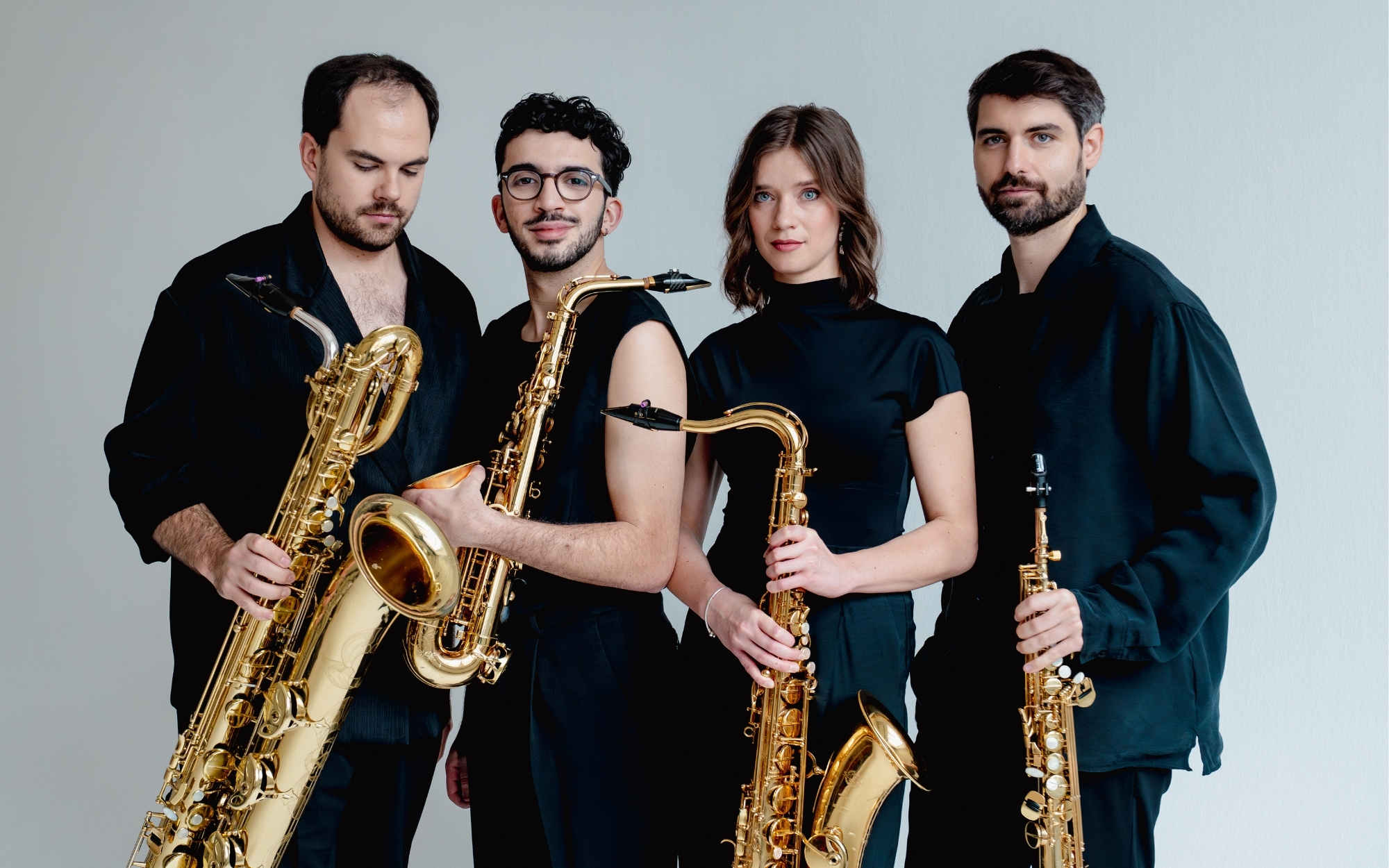
Arcis Saxophone Quartet
Sunday, November 8, 2026