


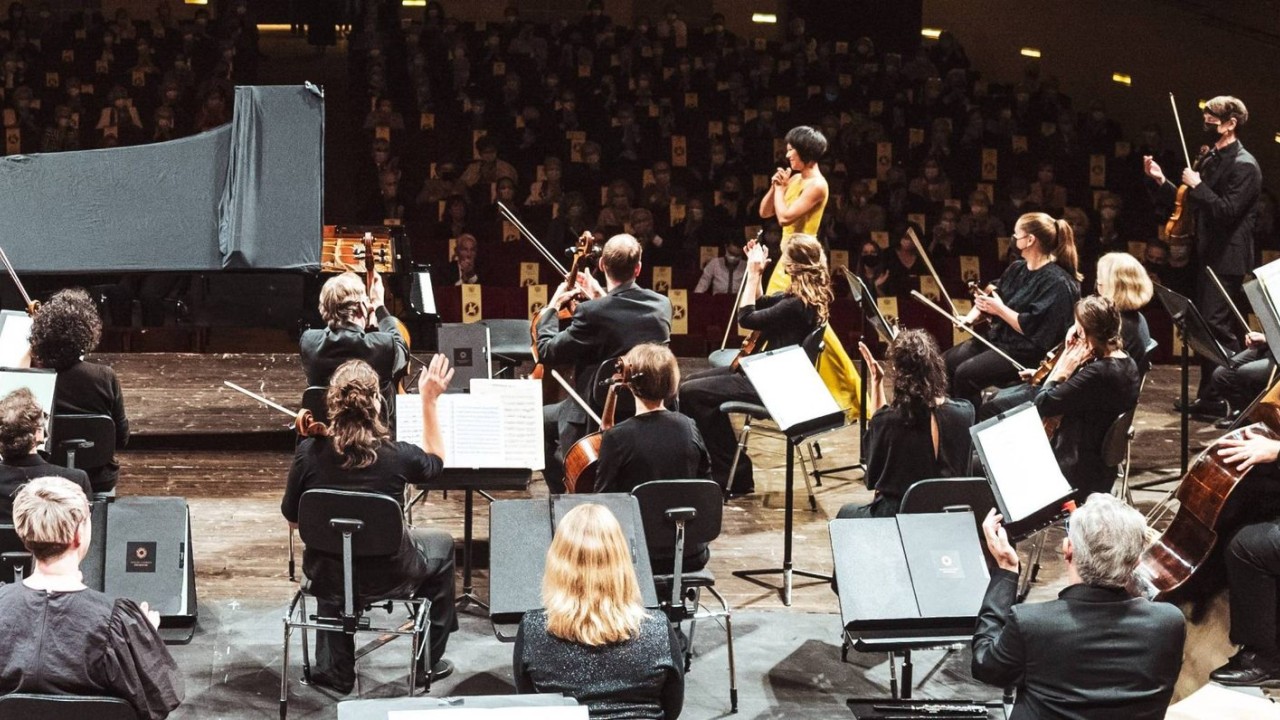
Program Notes for Mahler Chamber Orchestra
Yuja Wang, piano and director
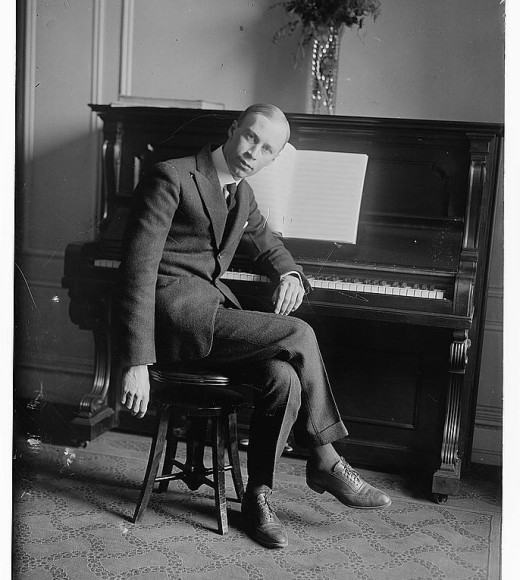
Sergei Prokofiev (1891–1953)
Symphony No. 1 in D Major, Op. 25 “Classical” (1917)
The young Sergei Prokofiev: prodigy, genius, phenomenon. Also: brat. Mouthy, brash, and impertinent, he left a trail of irritated professors in his wake while he produced a catalog of white-hot compositions that thrilled and repelled listeners in equal measure. It was as though he composed with a pen in one hand and a blowtorch in the other. His concert audiences weren’t sure whether he was playing the piano or trying to pulverize it.
As such he was very much a child of his times, for those times were cacophonous indeed. As of 1917, Russia’s disastrous entry into World War I had brought about the wholesale slaughter of the country’s young men on the battlefields. Tsar Nicholas II abdicated, eventually to be murdered along with his family. A Provisional Government and Russian Republic under Alexander Kerensky stumbled along shambolically before being wiped out by Lenin and the Bolsheviks. That led to civil war, violence, starvation, and social chaos.
None of that particularly bothered Prokofiev. The only child of a widow, he wasn’t likely to be called up for military service. He confessed in his diary that “I am neither a counter-revolutionary nor a revolutionary and I do not stand on one side or the other … I was amazed that during a time of war, revolution, civil war, and famine it was possible for a young man eligible for military service, and who was not wealthy, to live so well and so easily, without cares.” That sense of blithe insouciance in the midst of societal catastrophe fed into the creation of his first symphony, a witty update of the Viennese Classical style and just about the last thing anyone would have expected from a guy with such a reputation for musical mayhem.
Prokofiev’s motives for writing the symphony weren’t altogether noble. He aimed to cock a snook at the St. Petersburg musical establishment, all those condescending old fuddy-duddies and their pearl-clutching conservatism. “When our classically inclined musicians and professors (who in my opinion are really nothing more than false-classics) hear this symphony,” he wrote in his dairy, “they will start shouting about yet another impudent act committed by Prokofiev, and that he can’t even leave Mozart in peace in his grave, but had to disturb him with his dirty hands, sprinkling dirty Prokofievian dissonances among the pure classical pearls.”
What he wound up writing was a pearl in its own way, a direct counter to those behemoth symphonies of the late 19th century with their massive orchestral forces and endurance-contest lengths. Prokofiev’s Classical Symphony—that’s his title, by the way—is trim, buff, lightly orchestrated, and short. That makes it an early instance of the “neo-classical” style that is commonly associated with Stravinsky, but Prokofiev actually beat him to the punch with this sparkling cocktail, a definitive score of the neoclassical movement and one of the best-loved symphonies of the 20th century.
The first movement hews to Classical precepts by juxtaposing two keys against each other, each with its own dedicated theme. There’s even a propulsive ascent at the beginning, typical of the mid-18th century composers who worked for the Mannheim court. That’s not to say it’s a mere copy; the themes are subtly askew, the recapitulation begins in the ‘wrong’ key, and from time to time the rhythm takes a sudden zag where we might have been expecting a zig.
There was a lyrical soul lurking inside Prokofiev’s velociraptor exterior, and as he grew older he gave his inner songbird progressively greater latitude. The second movement offers a preview by way of lovely melodies suspended over a gently walking bass. For his third movement Prokofiev departs from Classical norms by offering a gavotte instead of the usual minuet, in a delectable galumph that was to make a future appearance in his ballet score Romeo and Juliet. To cap it all off, an exuberant finale positively zings with Haydn-esque athleticism and spring-loaded energy.
Alexander Tsfasman (1906–1971)
Suite for Piano and Orchestra (Jazz Suite) (1945)
Anyone who thinks that American jazz musicians had a rough time of it should take a look at their counterparts in the Soviet Union. Scandalized bluestockings in the West could disapprove all they wanted, but as a whole they lacked the political power to turn their distaste into official legislation. The Soviet authorities had the power, and they used it; they closed jazz clubs, disbanded ensembles, blacklisted and even imprisoned or exiled musicians. Jazz did not meet Soviet standards of ideological purity, so composers and performers alike were faced with a stark choice: assimilate or perish.
Ukrainian-born Alexander Tsfasman had a marginally easier time of it than most, partially due to his sterling credentials as a piano student of Felix Blumenfeld at the Moscow Conservatory, also from his ability to fuse state-approved stuff—military marches, victory songs, etc.—with light jazz elements. Still, he faced professional ruin from the same 1946 Zhdanov Decree that took a sledgehammer to Shostakovich, Prokofiev, and other leading Soviet concert composers. Like them, Tsfasman’s fortunes improved after Stalin’s death in 1953, but he remained an isolated figure, his many recordings restricted to Soviet markets while he was denied permission to travel to such international venues as the Monterey Jazz Festival.
Fortunately, sizeable tranches of Tsfasman’s recordings are now available via streaming, including his pioneering 1928 band recording of Vincent Youman’s “Hallelujah” on Side A and Harry Warren’s “Seminole” for the B side, the first domestic jazz record ever made in the USSR. The now-copious audio documentation reveals a pianist in the grand Romantic tradition, clear and refined, his tone never lapsing into harshness even in the most rhythmically energetic passages. (He must have been a whale of a Chopin player.) We can also hear him playing the accordion, at which he was self-taught. His various bands over the years tended more towards dance music than improvisational jazz, all buffed to a high polish by his mostly Conservatory-sourced players. His singers were equally well trained; they’re spot-on pitch perfect and sing without ‘jazz’ inflections. Many of them sound operatic, in fact.
Tsfasman’s 1945 Suite for Piano and Orchestra has been enjoying a renaissance of late, and with good reason. Tsfasman was as familiar with Western composers such as George Gershwin as was possible for a Soviet jazzman—three cheers for black markets—and he put his superb training to use in this well-written, utterly enjoyable confection that combines the sweet lyricism of Soviet jazz with superb keyboard writing and terrific orchestration.
“Snowflakes” opens the suite with Tsfasman’s sterling pianism on full display, in a three-part romp with a sparkling reprise reminiscent of Zez Confrey’s 1921 Kitten on the Keys, two instances of which flank an elegantly soulful interlude that channels such posh piano stylists as Eddie Duchin. “Lyrical Waltz” is just that, an irresistably hummable sweetheart of a piece that can’t resist adding tinkling triangle to its toe-tappy oom-pah-pahs. A subtle Russian afflatus only adds to its charm and allure.
The third-place “Polka” is adorable and funny, with a certain circus-clown je ne sais quoi. One can easily imagine it accompanying a Charlie Chaplin or Laurel and Hardy movie, underpinning all those pratfalls and double-takes. To conclude, a “Presto” that again summons up Zez Confrey, but this time via his 1923 hit Dizzy Fingers, that jet-propelled keyboard jamboree that was a surefire crowd-pleaser for popular pianists such as Dick Hyman and, as one can imagine, Alexander Tsfasman himself.
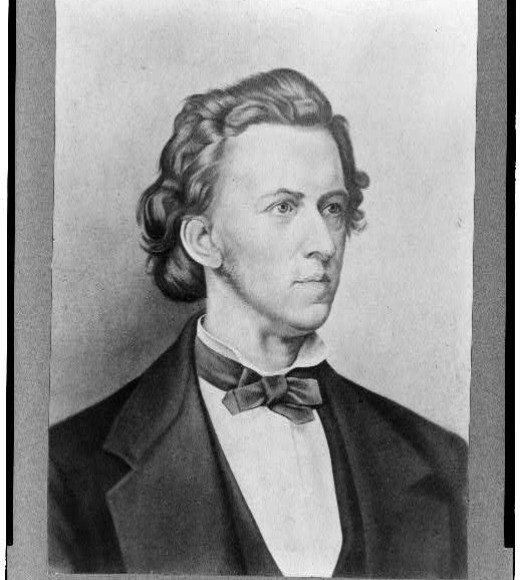
Frédéric Chopin (1810–1849)
Piano Concerto No. 1 in E Minor, Op. 11 (1830)
By the early nineteenth century the musical world was becoming democratized. Newly empowered middle classes were imparting a distinctly consumerist spin to traditional musical venues, and as the hold of the aristocratic elite over musical matters weakened, composers and performers came to realize that the future lay neither in court nor church, but in the concert hall, with or without those newfangled orchestras that were springing up everywhere. What with Europe being all aglow with sparkling operatic superstars, hopeful instrumentalists adopted a me-too attitude and took to the roads, each seeking his or her own path to celebrity and riches. Most of course promptly vanished. But there were a few who, by some alchemy of talent, ambition, and plain old luck, found an on-ramp to that superhighway that leads straight to wealth, status, and swooning fans.
From Beethoven’s era onward such instrumentalists were making their boodles as fashionable artistes who pocketed lucrative returns from their visits to major European cities. Their names are mostly unknown nowadays outside of academia; consider Henri Herz, Friedrich Kalkbrenner, Franz Clement, George Bridgetower, Daniel Steibelt, and Ignaz Moscheles. Before too long the first supervirtuoso appeared on the scene in the form of the cadaverous Italian violinist Nicolò Paganini, already considered a force of violinistic nature when his musical star went supernova upon his 1831 Paris debut. The Paganini electricity galvanized the career of a young Hungarian, Franz Liszt, who dedicated himself to becoming the Paganini of the piano and wound up as the über-virtuoso, the pianist to end all pianists.
Even before Liszt repurposed the once-humble clavecinist into a matinee idol, glittering showmanship was all the rage. The piano, newly pumped up with substantial technical upgrades, catapulted into dominance as the virtuoso instrument par excellence. Eager pianists surged into the musical marketplace, many of them heading straight for Paris, the acknowledged musical capital of the era. Any number of them were vapid tinklers at best, crass hucksters at worst. Much like their distant ancestors, the wandering troubadours, they performed mostly their own compositions, in their case typically sets of variations, operatic potpourris, and fantasias which might well have been improvised right on the spot. Best of all was the concerto, which treated the audience to the thrill of a soloist engaged in sonic battle with an orchestra, a tussle in which the pianist inevitably emerged triumphant after massive bombardments of arpeggios, octaves, and similar ordinance. It was all wonderful fun, everybody went home happy, and on occasion even some quality music-making featured in the evening’s entertainment. (Consider the undeniably effective concertos of the ultra-chic Friedrich Kalkbrenner, for example. His Opus 61 in D Minor is quite a satisfying romp, rather like unbuttoned Mendelssohn.)
The young Frédéric Chopin launched his career as an aspirant to the bread-and-circuses world of the touring virtuoso pianist. He discovered early on that he had little stomach for the life; not only was he thin-skinned about negative criticism, but he detested sacrificing his privacy to the gaping curiosity of the general public. Happily, Parisian success enabled him to earn a fine living as a highly regarded (and expensive) piano teacher, his income solidly bolstered by his publishing royalties. For him the hurly-burly was done by the mid 1830s; for the rest of his short life his public performances were vanishingly few.
Chopin’s two piano concertos were written within a year of each other, during those early days when he still had designs on the touring circuit. They were published in the reverse order of their composition, thus Piano Concerto No. 1 in E Minor, Op. 11 is actually the second, completed by the end of August 1830. Both concertos met with reasonable success, so Chopin played them regularly during his short but impressive performing career.
The E Minor concerto demonstrates Chopin’s often-discounted skill with classical forms and genres, in particular its superb finale that celebrates the krakowiak, a high-energy Polish dance. Undoubtedly it’s the bewitching second movement, marked “Romanze,” that stands out for most listeners. Chopin described it as a movement that “rests on a beloved landscape that calls up in one’s soul beautiful memories—for instance, a fine moonlit spring night.”
Scott Foglesong is the Chair of Music Theory and Musicianship at the San Francisco Conservatory of Music. A Contributing Writer and Pre-Concert Lecturer for the San Francisco Symphony, he also writes program notes for the California Symphony, Oregon Symphony, and Grand Teton Music Festival, among other groups. As a pianist, he studied at the Peabody Conservatory and SFCM.
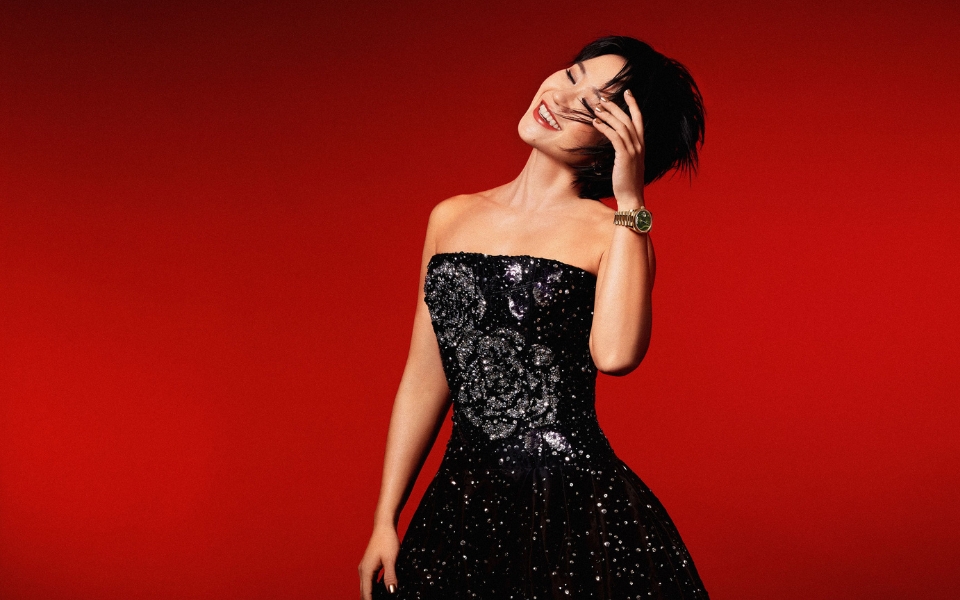
Mahler Chamber Orchestra
Yuja Wang, piano and director
Matthew Truscott, concertmaster and leader
Monday, April 27, 2026