


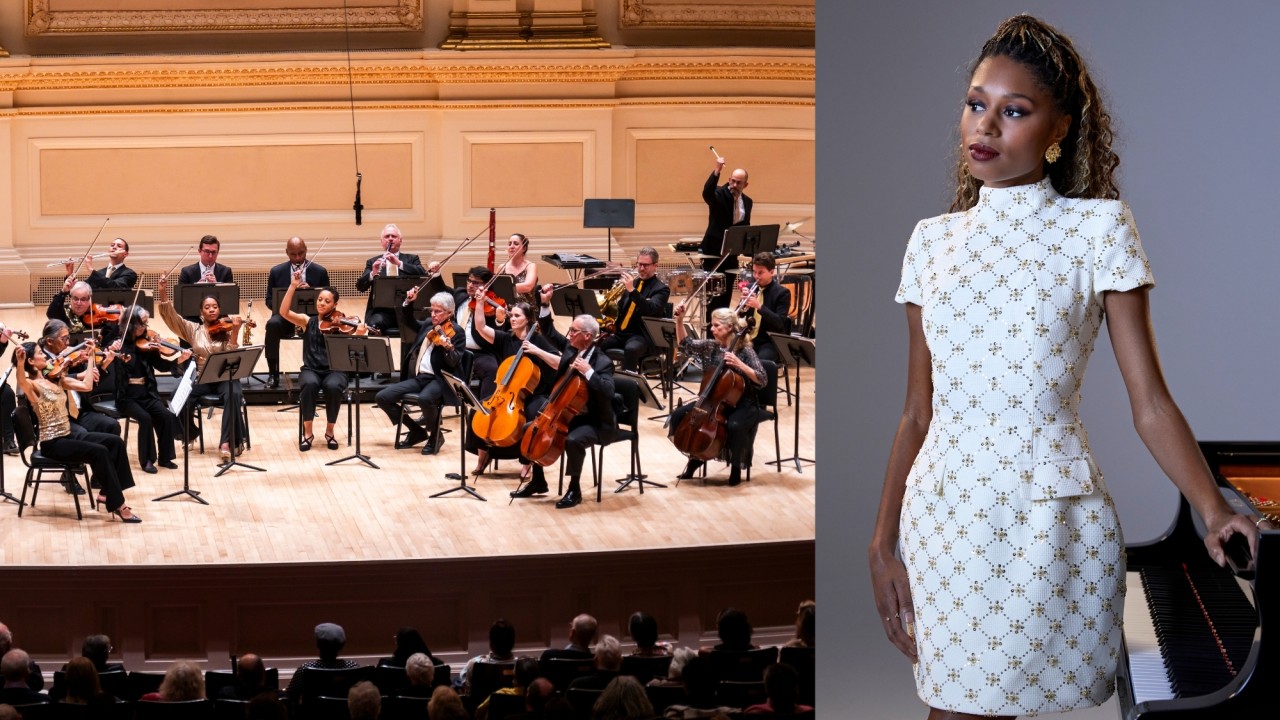
Program Notes for Orpheus Chamber Orchestra
Isata Kanneh-Mason, piano
Program
| Suite from “Water Music” compiled by James Wilson from HWV 348 & 350 | George Frideric Handel |
| Piano Concerto No. 27 in B-flat Major | Wolfgang Amadeus Mozart |
| Elixir of Life | Katie Jenkins |
| Symphony No. 91 | Joseph Haydn |
Program Notes
Water Music Suite (1717)
George Frideric Handel
Born in Halle, Germany, February 23, 1685; died in London, England, April 14, 1759
It was quite a path that brought two sons of Germany to the center of power in England. The composer George Frideric Handel had left his job in the opera orchestra in Hamburg to learn from the best in the business in Italy, and he was so successful there that he got hired at 25 to serve as the head of music for George Ludwig, ruler of the Electorate of Hanover that covered much of Northwest Germany. Meanwhile, because of an earlier British law that resolved a sectarian conflict by banning Catholic monarchs, George Ludwig—the great-grandson of England’s King James I—bypassed 56 closer relatives to become heir to the British throne.
The future King George I actually fired Handel after three years because the exceedingly ambitious composer was always off in London, where he established himself as the leading opera composer and impresario. But they reconciled after George’s coronation in 1714, and Handel became a trusted source of music for the royal court. In 1717, when a conflict with his liberal-minded son (the future George II) left the king in need of some good public relations, he organized an outing on the River Thames and asked Handel to provide orchestral entertainment. On July 17, 1717, the river filled with boats, including a barge loaded with some 50 musicians. The whole flotilla rode the tide upriver to Chelsea, stopped for supper, and then returned to Whitehall, with Handel’s new Water Music sounding all the while.
Water Music consists of three separate suites with different instrumentations that each emphasize particular wind and brass instruments, which had the advantage of being able to project their sounds more clearly across the water. The First Suite in F Major starts with an Overture that borrows the ceremonial style of France, along with a dash of Italian concerto grosso style reflected in the emphasis on oboes and solo violins in the fast section. That suite’s Allegro puts the spotlight on the two horns with rollicking music that evokes their traditional role transmitting long-distance communications for hunting parties.
The Third Suite in G Major features flute in the stately Sarabande, a dance style refined in France after Spaniards brought it back from their American colonies. The selection that hits closest to home is the Hornpipe from the First Suite, with oboes and bassoon approximating a simple reed instrument associated with the dance that shares its name, a staple of British sailors. The Gigue from the Third Suite, featuring piccolo, follows the French approach to a dance that evolved from the earlier jigs of the British Isles. Oboes take the lead again in the Andante from the First Suite that leaves its D-minor harmony hanging on an unresolved chord, leading to a surprise recap of the jubilant Allegro featuring horns.
— Aaron Grad
Piano Concerto No. 27 in B-flat Major, K. 595 (1791)
Wolfgang Amadeus Mozart
Born in Salzburg, Austria, January 27, 1756; died in Vienna, Austria, December 5, 1791
When Mozart, the former child prodigy, found himself still stuck at home in Salzburg in his early 20s with no suitable job offers, he took the leap of moving to Vienna in 1781 to start a freelance career. He soon attracted a loyal following of subscribers who attended the self-produced concerts that often featured his piano concertos, including the fifteen new ones introduced between 1782 and 1786.
Mozart completed only two more piano concertos after 1786, when war with the Ottoman Empire scattered Vienna’s elites and put a damper on his concert career. He may have begun the last one, No. 27 in B-flat Major, in 1788, but he only logged it in his catalog of completed works on January 5, 1791, 11 months before his death. Mozart wrote out cadenzas for the outer movements, which supports the hypothesis that his talented student Barbara Ployer gave the first performance at a concert in Vienna on January 9. (For works he was performing himself, Mozart usually improvised the cadenzas.) He did perform the concerto that March at a benefit concert for a clarinetist friend, in what proved to be his last known public appearance as a pianist.
Mozart, always an opera composer at heart, filled this concerto with sweet and cheerful tunes that simply beg to be sung. When the piano takes over the music introduced by violins at the start of the first movement, it incorporates florid decorations, similar to how a soprano might add flourishes to an aria. To begin the central Larghetto, the soloist enters alone with a theme of child-like innocence. The finale also opens with the piano presenting a disarming melody, one that Mozart reused a few days later in his setting of a poem titled Longing for Spring (K. 596) for an album of children’s songs.
— Aaron Grad
Elixir of Life (2026)
Katie Jenkins
Born in Pontypridd, Wales, 1999; currently resides in New York City and London
Katie Jenkins’ early passion and talent for composition brought her from her native Wales to The Juilliard School, where she earned her bachelor’s and master’s degrees as a student of Melinda Wagner. In her dynamic career as a composer and producer, Jenkins leans into collaboration with artists from wide-ranging disciplines while maintaining close ties with her own Welsh roots. She wrote the following program note for Elixir of Life, commissioned by Orpheus.
Elixir of Life traces the idea of transformation—from fragility to strength, darkness to light, and the mortal towards the eternal. What is initially unstable becomes increasingly grounded, radiant and expansive, ultimately becoming an embodiment of hope and a celebration of our capacity to raise up, transform and uplift others. Lilting folk melodies, modal harmonies, fiddle-like gestures, and the rhythmic vitality of South Wales weave through the music, gradually opening into expansive, pastoral landscapes. Against these textures, soaring solo violin lines emerge—at times lyrical and weightless, at others virtuosic and fiercely energetic.
The warmth and ancient resonance of Welsh folk music meet the groove, theatricality, harmonic color, and restless energy of New York City. These seemingly distant worlds become intertwined, creating a sound that is both intimate and cinematic, rooted and contemporary. Time stretches and contracts, melodies glide freely through moments of rubato, and moments of darkness continually give way to renewed brightness.
At its heart, Elixir of Life is a celebration of transformation, identity, and belonging. It asks where home resides—not simply in a place, but within the musical and emotional landscapes we carry with us.
— Katie Jenkins
Symphony No. 91 in E-flat Major (1788)
Franz Joseph Haydn
Born in Rohrau, Austria, March 31, 1732; died: Vienna, Austria, May 31, 1809
Haydn became a court composer for Austria’s wealthy Esterhazy family in 1761, and four years later he was put in charge of all the court’s vast musical activities. His patron, Prince Nikolaus Esterhazy, was an avid musician and a true supporter of the arts, but he kept his Kapellmeister on a tight leash, especially during the long stretches of time spent at an isolated summer palace where the musicians had to produce an endless stream of operas and other entertainment. Under those demands, Haydn later wrote, “I was forced to become original.”
In 1779, Haydn negotiated a new contract that gave him more leeway to compose and publish independently, allowing him to finally profit off of his widespread fame. A young French count soon commissioned six symphonies that debuted to great acclaim in Paris during the 1785-86 season, prompting the same count to follow up with a commission for three more symphonies in 1788, including this Symphony No. 91 that formed the middle of the set.
After decades of writing symphonies for the Esterhazy’s small court orchestra, the transition to composing for large ensembles in public venues led Haydn to expand his sonic palette to include trumpets and timpani (and soon clarinets in the symphonies he wrote for London). This Symphony in E-flat Major stands out as the final one to use the smaller configuration of his Esterhazy orchestra as of the early 1780s, with a single flute and pairs of oboes, bassoons and horns augmenting the strings. The musical material matches the intimate scoring, with a first movement that starts with a patient introduction using three very slow beats per measure, continuing into a fast body of the movement that retains the three-beat meter and a focus on themes that slide through off-key chromatic tones as they yearn for resolution.
The first audience in Paris must have been tickled by the second movement, a set of variations built around the typical rhythm of the French gavotte dance with its two tapping upbeats. The third movement Menuet reflects another tradition from the French dance suite, although in that case Haydn had been incorporating them for so long and had been so widely imitated that it had become a default component of a symphony, supplanting the original Italian format of three movements. The contrasting trio section in the middle has a more rustic character that matches a parallel dance tradition, the ländler of Haydn’s native Austria. The finale begins with one of Haydn’s favorite tricks, where a long passage of quiet music—whispered here by a stripped-down string ensemble—sets up the shock of the full orchestra blasting into action at a forte dynamic.
— Aaron Grad
Orpheus Chamber Orchestra
Isata Kanneh-Mason, piano
Violin
Miho Saegusa
Laura Frautschi
Liang-Ping How
Njioma Grevious
Renée Jolles
Isabelle Durrenberger
Maureen Nelson
Ruggero Allifranchini
Viola
Nardo Poy
Dov Scheindlin
Cello
Melissa Meell
Madeline Fayette
James Wilson
Double Bass
Jordan Frazier
Flute
Sooyun Kim
Oboe
James Austin Smith
Kemp Jernigan
Bassoon
Gina Cuffari
Adrian Morejon
Horn
Nicolee Kuester
Wilden Dannenberg
About the Artists
Orpheus Chamber Orchestra
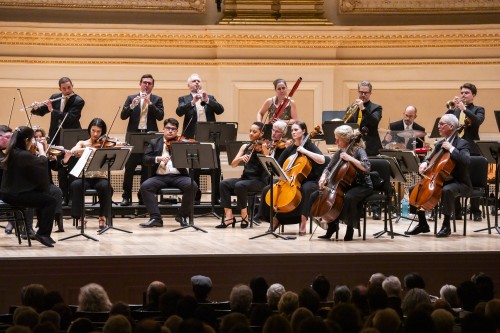
Orpheus Chamber Orchestra is a radical experiment in musical democracy, proving for over 50years what happens when exceptional artists gather with total trust in each other and faith in the creative process. Orpheus began in 1972 when cellist Julian Fifer assembled a group of New York freelancers in their early 20s to play orchestral repertoire as if it were chamber music. In that age of co-ops and communes, the idealistic Orpheans snubbed the “corporate” path of symphony orchestras and learned how to play, planand promote concerts as a true collective, with leadership roles rotating from the very first performance.
It’s one thing for the four players of a string quartet to lean into the group sound and react spontaneously, but with 20 to 30 musicians together, the complexities and payoffs are magnified exponentially. Within its first decade, Orpheus made Carnegie Hall their home and became a global sensation through tours of Europe and Asia. Their catalog of recordings for Deutsche Grammophon, Nonesuchand other labels grew to include more than 70 albums that still stand as benchmarks of the chamber orchestra repertoire, including Haydn symphonies, Mozart concertos, and 20th century gems by Stravinsky, Schoenberg, Raveland Bartók.
The sound of Orpheus is defined by relationships, and guest artists have always been crucial partners in the process. Orpheus brings out the best in their collaborators, with bonds that deepen over time, as heard in the long arc of music-making with soloists such as Richard Goode, Vadim Gluzman, Anne Akiko Meyers and Branford Marsalis, and in the commitment to welcoming next-generation artists including Nobuyuki Tsujii, Tine Thing Helsethand Caleb Teicher. By partnering with jazz legends Brad Mehldau, Wayne Shorter and Vijay Iyer, as well as actors Christine Baranski and Liev Schreiber, Orpheus expands the boundaries of what a chamber orchestra can achieve. Collaborating with composers like Jessie Montgomery, Billy Childs and Fazil Say has been another crucial way Orpheus evolves, commissioning numerous world premieres every year. Having proven the power of direct communication and open-mindedness within the ensemble, the only relationship Orpheus has never had any use for is one with a conductor.
At home in New York and in the many concert halls it visits in the U.S. and beyond, Orpheus celebrates over 50 years with a renewed commitment to enriching and reflecting the surrounding community. Orpheus Reflections™ brings the healing power of music to those living with dementia and their caregivers. Celebrating more than 20 years, Access Orpheus shares the orchestra's collaborative process with 1,500 New York City Public School students annually through coaching, school visits, and unparalleled access to Orpheus rehearsals and performances at Carnegie Hall. And through the Orpheus Leadership Institute, the musicians impart positive lessons of leadership and democracy to global organizations and businesses. Always evolving as artists and leaders, the Orpheus musicians carry their legacy forward, counting on their shared artistry and mutual respect to make music and effect change.
Isata Kanneh-Mason
piano
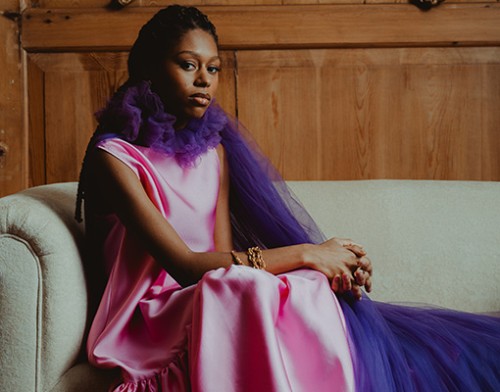
Pianist Isata Kanneh-Mason offers eclectic and stimulating recital programs with with repertoire encompassing Haydn and Mozart, Fanny Mendelssohn and Clara Schumann, Chopin and Brahms to Gershwin and beyond. In concerto, she is equally at home in Felix Mendelssohn and Beethoven as in Prokofiev and Rachmaninoff.
Isata is in high demand from concert halls and orchestras worldwide. In July 2024, she was invited to perform at the First Night of the BBC Proms at the Royal Albert Hall with the BBC Symphony and conductor Elim Chan, a performance which resulted in stellar reviews in the mainstream press. Isata went on to appear as concerto soloist with the European Union Youth Orchestra and Iván Fischer in summer 2024 performing Dohnányi’s Variations on a Nursery Tune at New York’s Carnegie Hall.
Highlights of the 2025/26 season include Rachmaninoff’s third piano concerto with Bar Avni and the Netherlands Radio Philharmonic at the Amsterdam Concertgebouw, and with Petr Popelka with the Prague Radio Symphony at the Rudolfinum. Isata makes further debuts with the Naples Philharmonic and Seattle Symphony, and returns to the City of Birmingham Symphony, the BBC Scottish Symphony, Detroit Symphony, and National Arts Centre Orchestra Ottawa.
Isata continues her collaboration with her brother, Sheku, for a European duo recital tour in February, taking in Paris, Madrid, Barcelona, Berlin, Geneva, Turin, Amsterdam and London’s Wigmore Hall. In the Americas, the duo will perform in Rio de Janeiro, São Paulo, Montevideo, Boston, Washington, D.C., Cleveland, and New York’s Lincoln Center. Isata also appears in solo recital and in chamber music at Wigmore Hall, with further solo recital appearances at the Isabella Stewart Gardner Museum in Boston, the Brucknerhaus in Linz, Powell Hall in St Louis, De Bijloke in Ghent, the Howland Music Circle in New York, Norwegian National Opera in Oslo, and a return to the Philadelphia Chamber Music Society among others.
In 2024/25, Isata gave performances with bass-baritone Gerald Finley in the Czech Republic and Germany, appeared in solo recital at the Lucerne Festival, Piano aux Jacobins Toulouse, the Schumann-Haus Düsseldorf, PHIL Haarlem, and on tour across the USA, and performed with the London, Bergen, Bremen and Dusiburg philharmonics, the North Carolina Symphony, and on tour with the Staatskapelle Weimar, and the Residentie Orkest.
Isata is a Decca Classics artist and has recorded four solo albums for the label—Romance (2019), Summertime (2021), Childhood Tales (2023), and Mendelssohn (2024). Her most recent release presents music from two Mendelssohn siblings, including the glittering First Piano Concerto by Felix and the long-lost “Easter Sonata” by his exceptionally talented but overlooked elder sister Fanny, alongside transcriptions of some of Felix’s most famous music by Rachmaninoff and Liszt.
Isata has received many awards, including the coveted Leonard Bernstein Award from the Schleswig-Holstein Festival and an Opus Klassik award for best young artist. She also enjoys composing and arranging and released two albums of her favorite works for intermediate and advanced piano students through ABRSM Publishing in 2023.
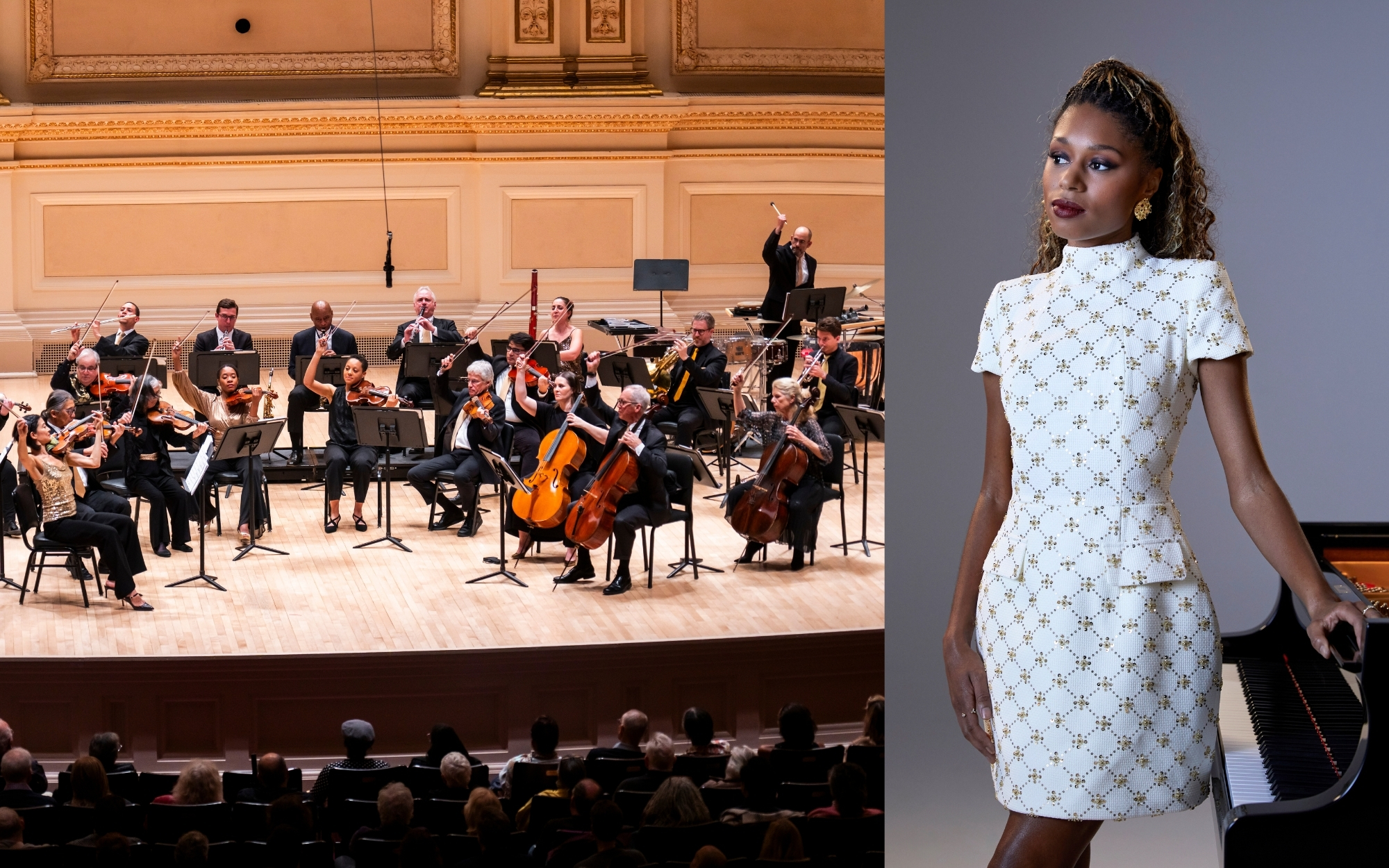
Orpheus Chamber Orchestra
Isata Kanneh-Mason, piano
Saturday, November 7, 2026