


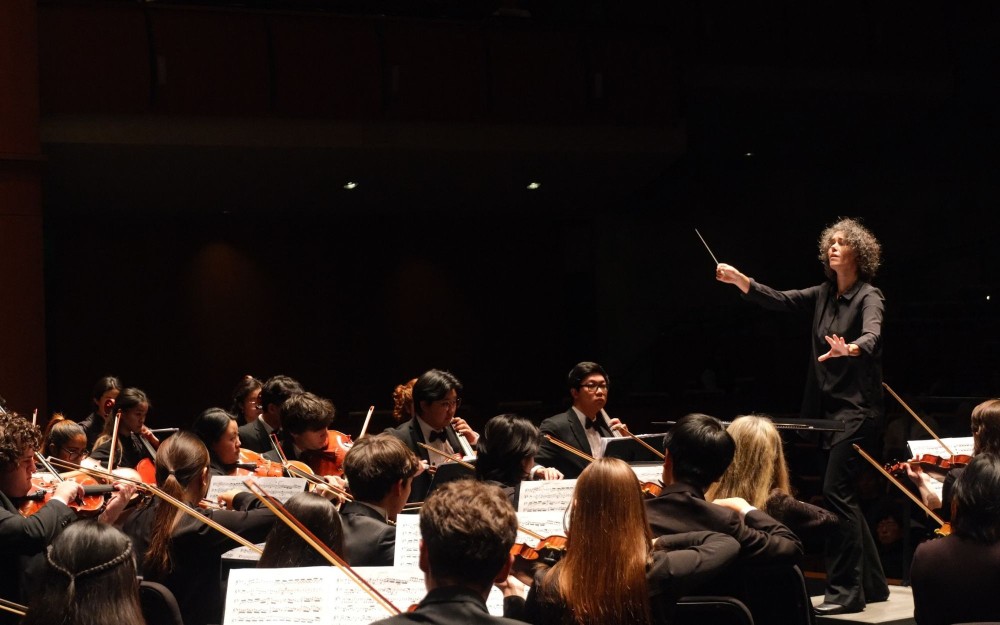
Lift every voice and sing. These program selections were written with strands of vocal material to elevate afflicted peoples.
In Shostakovich's Eleventh Symphony, we hear the tunes of Russian revolutionary anthems (“Listen,” “You Fell as Victims,” “Rage, Tyrants”) — folk songs that carry the memory of the people massacred by the Tsar in 1905 on Bloody Sunday. Grammy Award-winning composer Jessie Montgomery wove fragments of “Lift Every Voice and Sing” — itself an anthem written at the height of the Black American experience during Jim Crow — into her Hymn for Everyone, which was composed in the shadow of the pandemic. Alma Mahler's songs' existence run counter to Gustav Mahler's opposition to her artistry — which despite being written before her marriage to Gustav, is her own hymn to a voice she wasn't supposed to have.
“The music is at once absolutely gorgeous and extremely idiosyncratic. [Alma] clearly knew the musical language of her time — of art song especially — inside out, and she does the most bizarre, compelling, expressive things with that knowledge, while at the same time writing this extremely listenable, lush music.” — Sara Couden, contralto soloist (California Symphony)
Program
| Hymn for Everyone (2021) | Jessie Montgomery |
| Five Songs, arr. David and Colin Matthews | Alma (Schindler) Mahler |
| Symphony No. 11 in G Minor (“The Year 1905”) | Dimitri Shostakovich |
About the Artists
- Julie Miller, praised for the “arresting color” (Cincinnati Enquirer) of her voice, has appeared as a soloist with many orchestras and opera companies. Notable performances include Emilia (Otello), Annina (La traviata), Ida (Die Fledermaus), Krystina (The Passenger), Baroness Nica in Charlie Parker’s Yardbird plus understudies of Octavian (Der Rosenkavalier) and Waltraute (Die Walküre) with Lyric Opera of Chicago, Hackney Empire and Madison Opera. Her performance of the title role in Handel’s Ariodante was described as “deeply musical” by the Chicago Tribune and an “admirable and professional performance.” She has appeared on the concert stage as the mezzo-soprano soloist in Bach’s Magnificat and Cantata No. 6, Handel’s Messiah, Durufle’s Requiem, Beethoven’s Symphony No. 9, and Mozart’s Mass in C Minor and Requiem. Miller is a lecturer in voice at UC Davis.
- Matilda Hofman is Music Director of the Diablo Symphony Orchestra, Artistic Director of the Left Coast Chamber Ensemble, and conductor for the Empyrean Ensemble at UC Davis. She has guest conducted the Rochester Philharmonic, Fremont Symphony, Composers Conference, San Francisco Ballet, Festival Opera, and Earplay, among others. She has also guest-conducted orchestras at the Eastman School of Music, Oberlin Conservatory of Music, UC Davis and University of the Pacific. Matilda serves as a cover conductor for the San Francisco Symphony.
About the Composers
- Jessie Montgomery is a Grammy Award-winning composer, violinist, and educator whose music weaves together classical traditions, vernacular styles, improvisation, and poetry. She recently completed a three-year term as the Chicago Symphony's Mead Composer in Residence and is currently a doctoral candidate at Princeton. She was named Performance Today’s 2025 Classical Woman of the Year.
- Alma Mahler (1879–1964) was a Viennese composer and pianist whose own creative work was cut short early in her marriage, when Gustav Mahler pressed her to give up composing. The small number of songs she completed, mostly written before that marriage, are prized for their intensity and late-Romantic lyricism. She later became a central figure in Vienna's fin-de-siècle artistic circles.
- Dmitri Shostakovich (1906–1975) was among the most significant composers of the Soviet era, alternately celebrated and denounced by the state throughout his career. Best known for his symphonies, string quartets, and film scores, he wrote Symphony No. 11, "The Year 1905," as a programmatic memorial to the Bloody Sunday massacre — one of his most overtly historical and political works.
This event is not a Mondavi Center Presents event and is not eligible for a Mondavi Center subscription package or Student Rush. No refunds, exchanges, or event credit.
Run time is approximately 120 minutes with one intermission.