


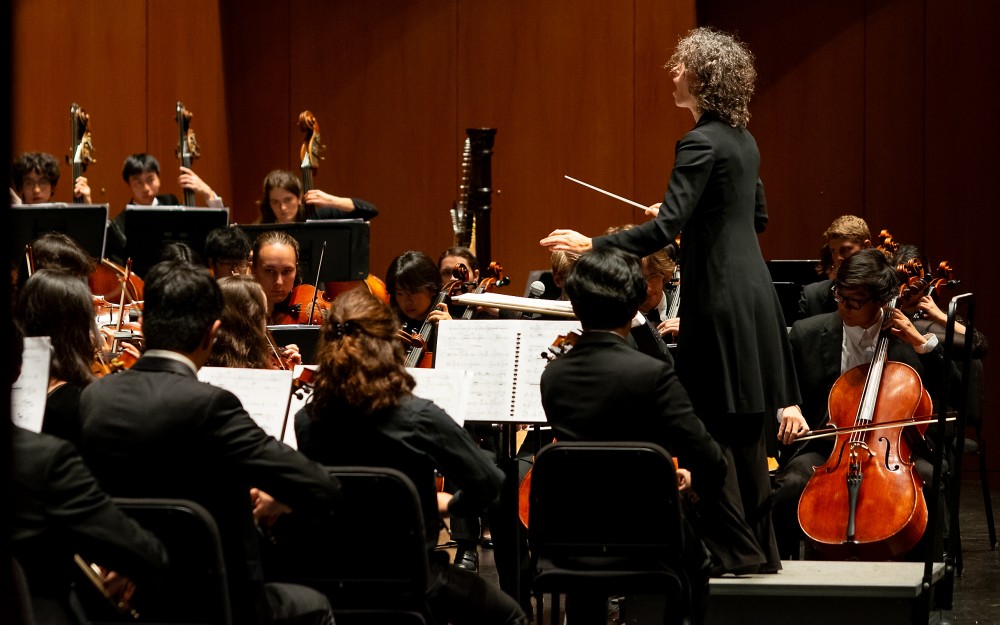
This program catches three composers at the threshold of something new: Lili Boulanger's shimmering D'un matin de printemps paints the light of a season's first morning; Beethoven's Symphony No. 1 is the first of what would become one of the most consequential symphonic cycles in music history; and Poulenc's Double Piano Concerto — which he called the start of his "great period" — uses some of the exquisite colors of a Balinese gamelan he heard in Paris just the year before. Together, they capture that particular brightness of a first light: old forms cracked open by young, restless voices.
Program
| D'un matin de printemps | Lili Boulanger |
| Concerto for Two Pianos in D Minor | Francis Poulenc |
| Symphony No. 1 in C Major | Ludwig van Beethoven |
About the Artists
- Natsuki Fukasawa, a Steinway Artist, has performed across the U.S., Europe, Scandinavia, Israel, Australia, Brazil, Japan, and China, at venues including Carnegie Hall and the Kennedy Center. Juilliard-trained with a doctorate from the University of Maryland, she teaches at UC Davis, American River College, and the University of the Pacific, and has recorded for the Classico and Da Capo labels.
- Richard Cionco, a Steinway Artist and Professor of Piano at California State University, Sacramento, has been praised by the New York Times for his sensitive pianism. A Juilliard graduate and former teaching fellow to David Dubal, he has performed as soloist, chamber musician, and recitalist across the U.S., Europe, and Asia, and recorded acclaimed solo albums of Latin American piano music and Beethoven's late works.
About the Composers
- Lili Boulanger (1893–1918) was a French composer and the first woman to win the Prix de Rome in composition, in 1913. Trained at the Paris Conservatoire and mentored by her sister Nadia, she was chronically ill for most of her life and died at 24. Her small but striking body of work blends late-Romantic harmony with early Impressionist color.
- Francis Poulenc (1899–1963) was a French composer and pianist, a member of the group known as Les Six, celebrated for his melodic wit and stylistic range across sacred choral music, opera, and song. His Concerto for Two Pianos, commissioned by Princess Edmond de Polignac in 1932, fuses Mozartean neoclassicism with jazz and the Balinese gamelan sounds he encountered at a Paris exhibition.
- Ludwig van Beethoven (1770–1827) remains one of the most influential composers in Western music history. His Symphony No. 1, premiered in 1800, is his first mature statement in the genre — still grounded in the Classical language of Haydn and Mozart, but already showing the individuality and ambition that would define his later work.
This event is not a Mondavi Center Presents event and is not eligible for a Mondavi Center subscription package or Student Rush. No refunds, exchanges, or event credit.
Run time is approximately 75 minutes with one intermission.